
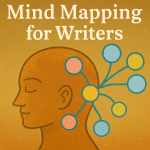
Mind mapping is a visual brainstorming technique used to organize information and ideas in a structured, easy-to-understand format. It involves creating a diagram that starts with a central concept or topic and branches out into related subtopics, ideas, or themes. I find mind mapping to be an essential tool for writing. During the planning phase it's useful to flesh out ideas and during the writing phases, it's a frequently reminder of important concepts and story details.
Benefits
- Enhanced Creativity: By visually organizing thoughts, mind mapping encourages creative thinking and idea generation.
- Improved Memory: The combination of words and visuals helps improve retention and recall of information.
- Clear Structure: It provides a clear overview of complex topics, making it easier to see relationships and hierarchies.
- Flexible and Adaptive: Mind maps can be easily modified or expanded as new ideas emerge.
Overall, mind mapping is a versatile tool that can enhance productivity, creativity, and understanding.
Ways to Use Mind Mapping
 1. Central Idea Expansion (Classic Mind Map
- How it works: Start with a central concept in the middle of the page. Branch out with related ideas, then sub-branches for details.
- Best for: Brainstorming, planning essays, studying complex topics.
- Example: For “Climate Change,” branches might include “Causes,” “Effects,” “Solutions,” and “Policy,” each with sub-branches like “Fossil Fuels” or “Carbon Tax.”
 2. Concept Clustering
- How it works: Group related ideas into clusters without strict hierarchy. Useful when connections are fluid or evolving.
- Best for: Creative writing, product development, or exploring abstract ideas.
- Example: For a novel, clusters might include “Characters,” “Themes,” “Settings,” and “Plot Twists,” with notes scattered and loosely connected.
 3. Flow Mapping
- How it works: Use arrows to show sequences, processes, or cause-effect relationships.
- Best for: Project planning, workflows, decision trees.
- Example: A startup launch map might flow from “Idea” → “Market Research” → “Prototype” → “Funding” → “Launch.”
 4. Goal-Oriented Mapping
- How it works: Begin with a goal and map out steps, resources, obstacles, and milestones.
- Best for: Personal development, strategic planning.
- Example: For “Learn Spanish,” branches could include “Daily Practice,” “Apps,” “Travel,” and “Language Exchange.”
 5. Reverse Mapping
- How it works: Start with a result or conclusion and work backward to identify contributing factors or steps.
- Best for: Problem-solving, root cause analysis.
- Example: For “Missed Deadline,” reverse map to “Poor Time Management,” “Unclear Scope,” “Team Miscommunication.”